


Investigating the Night Sky: A Girls in STEM Astronomy Experience
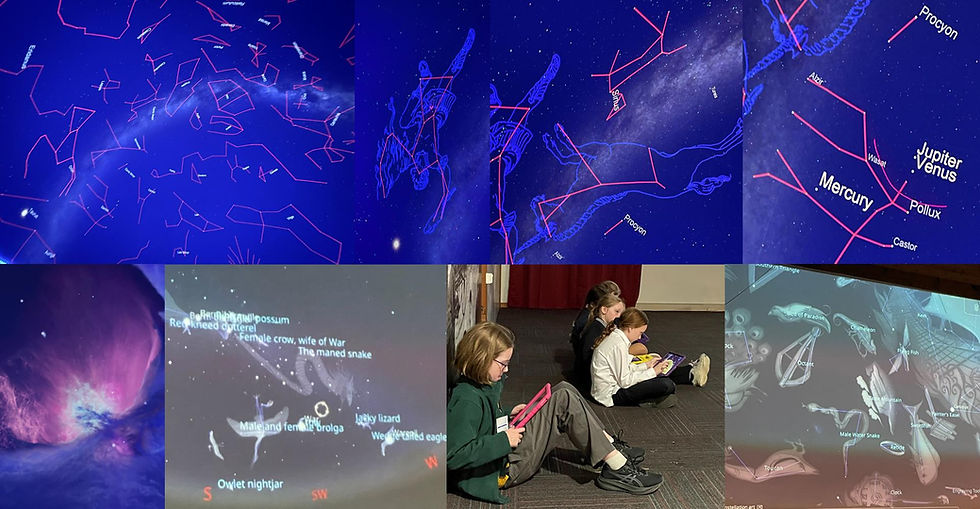
This week, the Girls in STEM Club participants were introduced to the fascinating world of astronomy, the scientific study of celestial objects and phenomena in space.
Seated comfortably on the Planetarium floor, the girls gazed at the night sky projected above them through the Stellarium platform. They learned about the constellation Orion, known as “The Hunter” in Greek mythology, and discovered that Sirius, the brightest star in the night sky, belongs to the nearby constellation Canis Major, or the “Big Dog.” They also identified the group of stars known locally as the Saucepan at the foot of Orion, as well as the constellations Canis Minor (the “Small Dog”) and Monoceros (the Unicorn), located between the two dogs.
The session included a discussion about the current alignment of Venus, Mercury, and Jupiter, which can be observed with the naked eye at this time of year. The girls also learned that a horoscope sign is determined by the position of the Sun at the time of a person’s birth. Then they explored the Orion Nebula, observing light from a formation that originated millions of years ago as a massive cloud of interstellar gas and dust.
To keep the participants engaged, they took part in a treasure hunt around the displays at the Discovery Science and Technology Centre. Afterwards, using iPads and the free astronomy software Celestia, the girls explored constellations, stars, and nebulae while accessing fascinating information about each object.
The program also highlighted how different cultures interpret the night sky. The girls learned that the Bunurong people, for example, used the stars to guide their migrations and recognised a constellation known as the Emu. They were particularly fascinated to discover that the software can recreate the night sky as it appeared at the time of their birth.
Through hands-on activities exploring stars, constellations, and nebulae, the Girls in STEM Club deepened their understanding of astronomy while developing curiosity, collaboration, and confidence in interpreting the universe.


Comments